
Can a Home Energy Assessment Tell If Your High Bill Is ‘Usage’ or ‘House Leakage’ (and how)?
You take out your utility bill, and your heart skips a beat. The figure is huge once again. The immediate thought is that it was the family habit: someone left the overnight lights on, the children took lengthy showers, or the thermostat was too high during that cold spell. Sound familiar?
However, the truth is what the majority of homeowners do not know: it may not be your lifestyle that is driving such high energy bills. Rather, it may be a hidden culprit: house leakage. We are speaking of insulation holes, framing air infiltration, window and door air leaks, ductwork systems that have not been sealed, and thermal bridges that are costing your wallet dollar after dollar.
The frustrating part? You cannot tell by merely looking at your bill or by passing through your house. This is where a professional home energy assessment can be beneficial. It's the only definitive way to separate "lifestyle costs" from "building failure costs" and finally understand whether your high energy bill causes stem from how you live or how your house performs.
Ready to Improve Your Home's Efficiency?
Contact Home Efficiency Experts for a thorough home assessment or to book your service.
Get A Free Home AssessmentHow Home Energy Assessments Tell You If Your High Bill Is 'Usage' or 'House Leakage'
A complete home energy audit is not one based on supposition. Rather, it takes scientific testing and diagnostic aids to identify where exactly your energy dollars are going. We can disaggregate the process of energy professionals, differentiating between house leakage and usage problems.
1. Diagnosing House Leakage
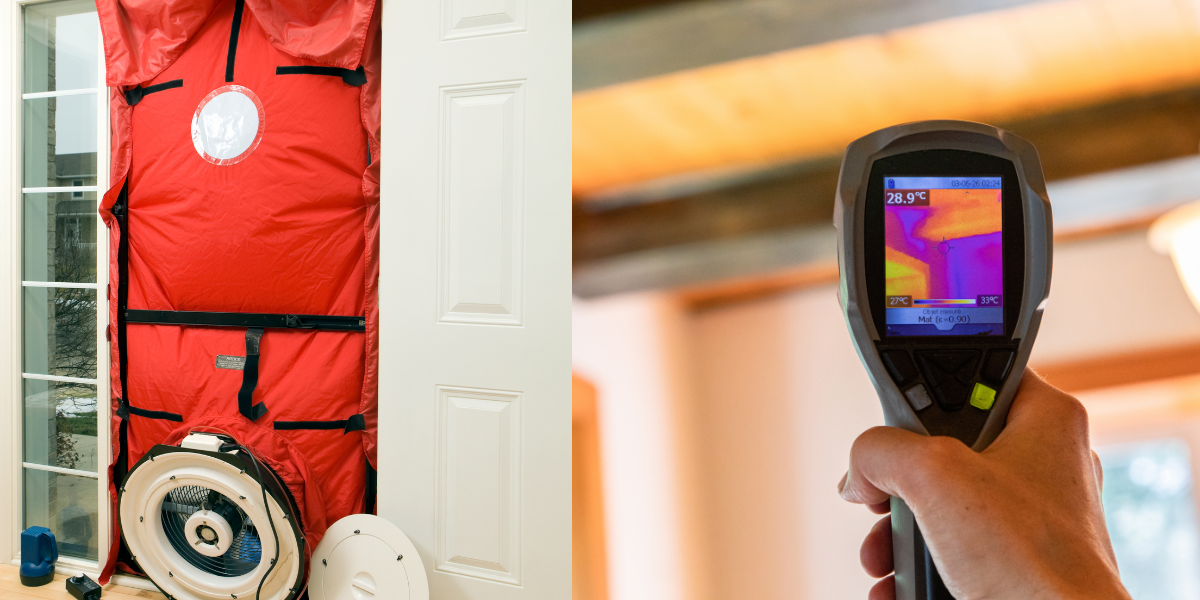
In case your house is structurally inefficient, it is like heating or cooling a house with the windows open. The problem may not be so obvious, but it is costing you a lot. This is the way professionals detect air leakage home problems:
➔ The Blower Door Test: Quantifying Air Infiltration
The blower door test is the most reliable method for assessing the leakiness of your home. In this test, a powerful fan will be installed in the outer door to create a pressure difference between the inside and outside of your house. This difference in pressure pushes air through all cracks, gaps, and holes that are found in the building envelope.
The test measures air leakage in CFM (cubic feet per minute) and provides you with the exact number that is used to show you how much conditioned air is escaping and how much outside air is intruding. A normal older house could have a rate of 10-15 air changes per hour, and an efficient modern house must be near 3-5 air changes per hour.
➔ Thermal Imaging: Seeing the Invisible
Although the blower door test measures air leaks, thermal imaging inspection reveals the location of air leaks. Energy auditors can highlight this using infrared cameras and the difference in temperature on your walls, ceilings, and floors that cannot be seen with the naked eye.
In a thermal imaging inspection, colder places are represented as another color on a camera screen and show:
● Lacking or poor-quality insulation on walls and attics.
● Leaks of air around windows, doors, and power outlets.
● Thermal bridges are where heat conducts through framing members.
● Moisture intrusion that reduces insulation effectiveness.
● Ductwork leaks in unconditioned spaces.
These thermal images provide indisputable physical evidence of where your home is losing energy. When you look at your wall in the winter with a bright blue spot (which means there is heat going out of the house) or a red spot in the summer (which means heat is coming in), you instantly know why your HVAC system is unable to keep pace.
What This Tells Us About Your Bills
When your home energy assessment shows that there is a lot of air leakage and a lack of thermal insulation, and yet your usage behaviors are not excessive, the diagnosis is obvious: house leakage is the culprit. You can switch all lights off, take cold showers, and run very few of your appliances, yet you would have high bills as the building envelope of your home was failing.
The good news? After discovering these structural problems, you can correct them forever. One-time investments such as air sealing, adequate insulation, and treatment of thermal bridges reduce electric bill costs for years to come.
Ready to Improve Your Home's Efficiency?
Contact Home Efficiency Experts for a thorough home assessment or to book your service.
Get A Free Home Assessment2. Diagnosing Usage Issues

Conversely, other houses are structurally good, yet they run high bills in energy consumption because of lifestyle aspects and ineffective machines. The following is the way in which the energy professionals detect the problems associated with the use:
➔ Energy Usage Review: Analyzing Your Consumption Patterns
An in-depth home energy audit would require an extensive examination of past utility bills within 12–24 months. The patterns sought by energy auditors are indications of problems with usage:
● Ambitiously high consumption in particular months.
● Even in mild weather, it has a high baseline usage.
● Spike events that are associated with particular events or household occupancy.
● Comparison of your use to other similar homes in your area.
Even in a house with an efficient structure, this analysis can demonstrate whether you consume much more or less energy than some similar households. As an example, in case your summer bills are three times more than your spring bills and your home passes the blower door test with flying colors, then it was the air conditioning use that was the problem, not air leakage.
➔ Appliance & Lighting Inspection: Finding the Energy Hogs
In modern energy audits, there is a detailed examination of your current usage of energy within your home. Auditors examine:
● HVAC systems: Does your heating and cooling system size, maintain, and run efficiently? A check of the HVAC efficiency check can indicate systems that are oversized, undersized, or have simply outlived their usefulness.
● Water heating: Does your water heater look excessive? Is it an outdated and inefficient model? Are you using a tankless system, which could be more efficient?
● Major appliances: Are your refrigerator, washer, dryer, and dishwasher energy hogs from a previous decade?
● Lighting: Do you still use incandescent lighting rather than LED?
● Electronics and phantom loads: How many of your devices are left on 24/7, even when they are “off”?
Specialized meters are frequently employed by energy auditors to measure the real power used by individual appliances and circuits and eliminate all of the guesswork out of the equation.
What This Tells Us About Your Bills
When the building envelope of your home is tight (you achieved good results in your blower door test) and your thermal imaging indicates that you are well insulated, but your bills are still high, then usage issues are the diagnosis. This might mean:
● Your HVAC system is inefficient or oversized.
● You are setting your thermostat to high temperatures.
● Old appliances are consuming excessive power.
● Your family's habits are genuinely energy-intensive.
The solution here is different from structural problems. Rather than investing in air sealing and insulation, you'd focus on upgrading equipment, adjusting thermostats, replacing appliances, and modifying behaviors.
Why Choose Home Efficiency Experts for Your Home Energy Assessment
All home energy assessments are not created equal when it comes to knowing more about your energy bills and making your home work better. Home Efficiency Experts offers a more in-depth, science-oriented view of energy audits and extends further than mere visual inspection.
The following is what differentiates us:
● Advanced Diagnostic Equipment: Our diagnostic testing is based on the professional quality of blower door testing equipment and a high-quality thermal imaging camera to give a precise and detailed analysis of home performance. Our equipment complies with or even exceeds the industry requirements established by various agencies such as the Building Performance Institute (BPI) and RESNET.
● Certified Energy Auditors: Our crew is a group of trained and certified experts familiar with building science, heating/air conditioning, and efficiency measures. We do not just come up with an identification of the problems; we know the reasons why they are occurring and how to correct them affordably.
● Comprehensive Reporting: Based on your home energy audit, you will receive a comprehensive report, which will include:
○ Blower door test results with CFM measurements.
○ Thermal photographs of problem areas.
○ List the suggested improvements with the highest priority.
○ Recommendation for relative savings and estimated costs.
○ Payback periods to aid you in making intelligent investments.
● Local Expertise: Home Efficiency Experts is serving the needs of Long Island homeowners and knows the challenges of our climate, humid summers that put a strain on air conditioning, and cold, windy winters that cause all of the air leaks to be seen. We are well-versed in building codes locally and commonplace construction techniques in the region, as well as utility rebates and incentives.
● Whole-House Approach: We do not work on a system or area. Our home energy assessment assesses your whole home as a systems-based structure and takes into account the interaction of various parts of your home. This is a whole-body strategy that will ensure that we are able to find the cause of your energy issues and not the symptoms.
Conclusion
Are you fed up with being the detective when it comes to analyzing your utility bills and whether to attribute them to the excessive showers of your teenager or that draft from your bedroom window? It is time to adopt a different strategy. The professional home energy assessment removes all uncertainty and provides clear answers regarding whether the causes of your high energy bill are related to usage or house leakage.
The fact is that in the majority of houses, there is a complex of both problems. You may be having serious issues with air leakage home and inefficient HVAC. Or maybe you have sufficient insulation, but you have obsolete appliances that are using too much power. You could be spending money without knowing where to invest it, without proper testing, such as a blower door test and a thermal imaging inspection.
Book a comprehensive Home Efficiency Experts energy audit today and take the first step toward understanding and solving your high energy bill mystery. Our team serves Long Island homeowners who are ready to transform their homes from energy-wasting liabilities into efficient, comfortable spaces.
Ready to Improve Your Home's Efficiency?
Contact Home Efficiency Experts for a thorough home assessment or to book your service.
Get A Free Home Assessment